
How to Dress for the Airport: Men’s Style Guide

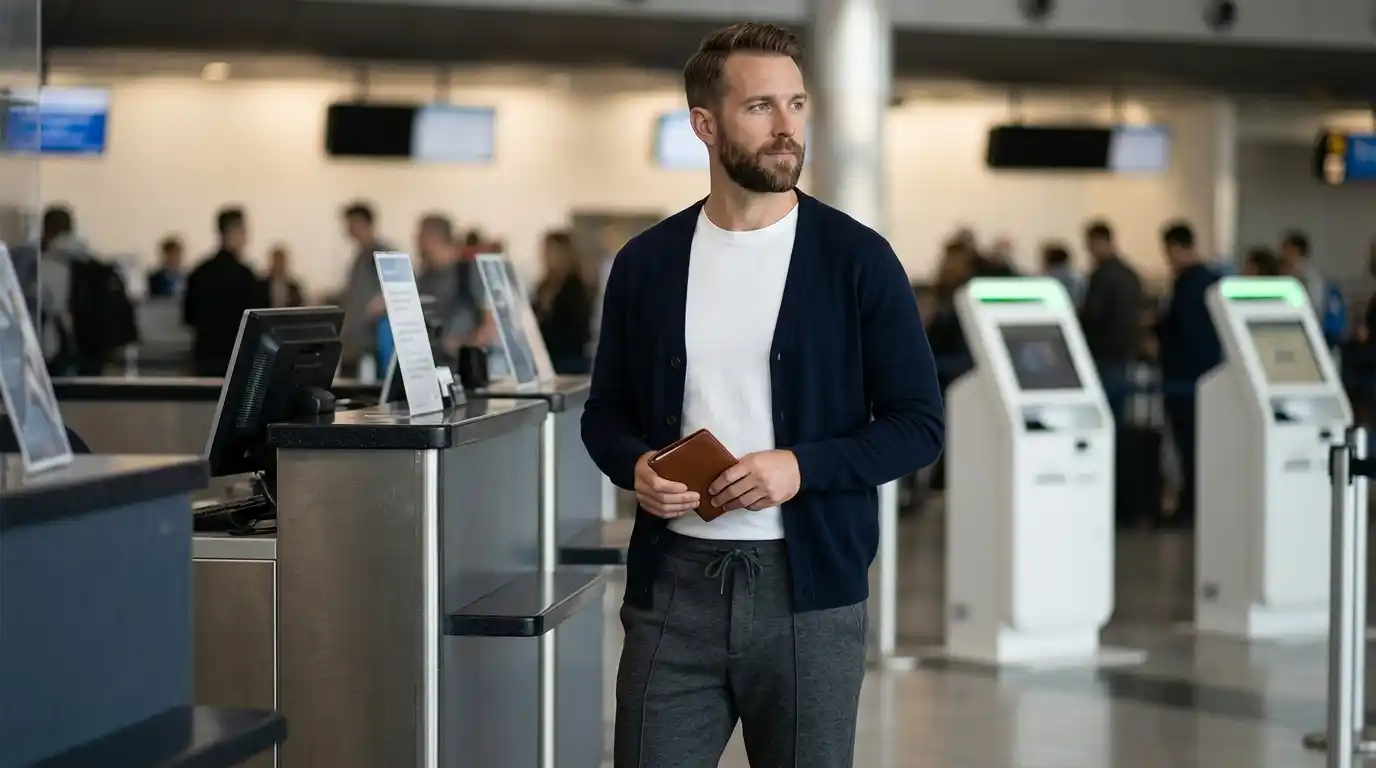
The days of choosing between a rigid, stiff suit or looking like you just rolled out of bed in faded college sweatpants are officially dead.
Men struggle to find the intersection of absolute physical comfort and professional presentation.
Traveling often means dealing with extreme cabin temperature drops and frustrating security lines.
This step-by-step men’s travel style guide changes that. You will learn a clear blueprint to master architectural layering.
You will discover how to secure the right footwear. Finally, you will learn to select fabrics that remain crisp from check-in to your arrival destination.
Mastering how to dress for airport men is the ultimate silent upgrade for your next trip.
Here is how to build comfortable airport outfits for men that actually look sharp.
The Foundation: Breathable Base Layers

Every failed travel outfit starts with the wrong base layer. If your first layer traps sweat or scratches your skin, the rest of your outfit will feel miserable.
Many men defaults to cheap graphic t-shirts. These basic travel tees look sloppy and trap odors during long delays.
You need to upgrade your breathable foundations. Look for 280-gram heavyweight organic cotton tees or premium merino wool.
Merino wool is a superpower for travel. It naturally resists odor molecules for up to 48 hours of transit. It also regulates temperature when you run between gates.
Foundation Checklist
- Premium 280g heavyweight cotton t-shirt (adds structure)
- Merino wool crewneck (odour resistant for 48 hours)
- Knit knit polo with an open-camp collar
A premium collar profile immediately anchors your mid-layers. A structured knit polo or a clean zip polo elevates your style instantly.
It feels as soft as a t-shirt but looks sharp enough for a business meeting.
This simple switch keeps you comfortable in cramped middle seats while looking professional.
Choose a mid-weight thickness so your underwear line stays hidden.
The Mid-Layer Strategy: Mid-Weight Textures & Co-ords
Airports are a chaotic mix of microclimates. You must deal with hot tarmacs, humid jet bridges, and freezing cabins.
Traditional pullover hoodies fail at security checkpoints because they lack a front zipper.
Pulling a tight hoodie over your head at the gate messes up your hair and knocks your headphones loose.
Instead, look for a modern men’s holiday co-ord. Matching zip-polo or clean knit sets make you look intentional.
Monochromatic sets in navy, olive, or charcoal visually elongate your frame. They provide soft-milled lounge comfort without looking like pajamas.
Warning: Avoid bulky outerwear that does not fit under an airplane seat. If you must carry a heavy coat, wear it onto the plane to save luggage space.
A technical shacket or a structured overshirt works perfectly over your base tee. Look for jackets with secure zip pockets to hold your passport and boarding pass.
This keeps your hands free while walking through the terminal. If a layer requires you to fight with it for 30 seconds to take it off, leave it home.
The Bottom Half: Trousers Built for Long-Haul Seating

Your lower half bears the brunt of physical travel strain. Rigid raw denim or ultra-slim cuts constrain blood flow and ruin long flights.
They pinch your waist and restrict your movement when you sit for hours.
You need to transition to modern travel chinos or tailored joggers.
Look for pants made from Japanese 4-way stretch twill or technical nylon blends.
These fabrics offer the crisp look of tailored trousers. However, they possess up to 15% elastane stretch to allow full knee flexion.
| Pant Type | Pros | Cons |
| Technical Chinos | Looks professional | Higher cost |
| Tailored Joggers | Maximum comfort | Can look too casual |
| Rigid Denim | Durable | Restricts blood flow |
These wrinkle-resistant pants utilize fabric memory to keep their shape.
They will not bag out at the knees or sag at the waist after a red-eye flight. Use this quick checklist when buying your next pair of travel pants:
- Look for a hidden elastic waistband or internal drawcords.
- Check for at least two secure zippered pockets.
- Verify the ankle hem clears your shoes without bunching.
TSA-Proof Footwear & Functional Accessories
Nothing ruins terminal momentum faster than getting pulled aside for a full shoe inspection.
Over 75% of airport hubs globally use advanced body scanners.
These machines require shoe removal if your footwear contains steel shanks, heavy metal eyelets, or thick soles.
The gold standard for travel is low-profile, clean travel sneakers in white leather. You can also opt for luxury slip-on footwear like suede loafers.
These styles slip off easily at security and slide back on in seconds.
Ensure your shoes feature supportive EVA-midsoles to cushion your feet across massive terminal walks.
The TSA-Proof Footwear Hierarchy
1. Clean Leather Slip-on Loafers (Best for style and speed)
2. Low-Profile White Leather Trainers (Best for versatile walking)
3. Technical Running Shoes (Best for pure comfort)
Keep your accessories minimal to save time. Avoid heavy jewelry, metal belt buckles, and decorative chains that trip metal detectors.
Swap your metal-buckle belt for a woven elastic version.
Finally, pack your gear into a 35L personal-item compliant backpack using compression packing cubes.
This functional luggage fits under the seat in front of you, allowing you to bypass the baggage carousel completely.
Pristine, scuff-free footwear ties the entire look together.
Conclusion
Recalibrating your travel uniform relies on three factors: breathable base layers, stretch-infused bottoms, and zip-accessible layers.
Ditch the collegiate sweatpants on your next flight.
Build a modular system today and notice how differently terminal staff, lounge attendants, and hotel agents treat you.
Dressing well opens doors when you travel. Mastering how to dress for airport men is the ultimate silent upgrade for the modern traveler.

