How to Create a 30‑Day Minimalist Outfit Challenge for Men

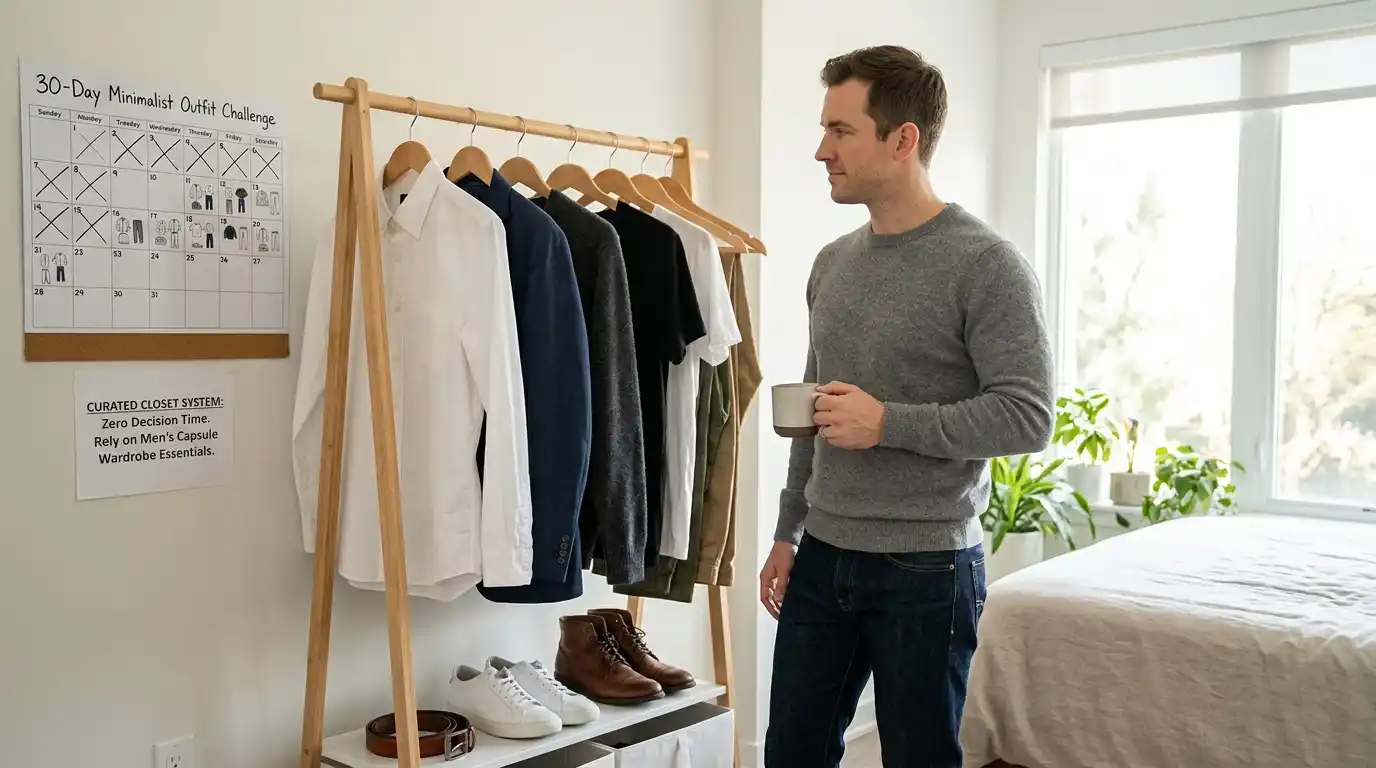
If you stare at a packed closet every morning and still feel like you have nothing to wear, you are a victim of the modern choice paradox.
The average man wastes up to 15 minutes a day deciding on an outfit.
This habit clutters your mind before your workday even begins with fast fashion trends that expire in months.
You do not need more clothes. You need a better system.
This guide details how to execute a 30-day minimalist outfit challenge using a curated closet that cuts decision time to zero.
By learning to rely on men’s capsule wardrobe essentials, you will change how you get dressed every morning.
Why Modern Closets Cause Decision Fatigue

Every minor decision you make before 9:00 AM drains your limited reserve of daily willpower.
When you look at a messy wardrobe, your brain works overtime to process colors, fits, and styles.
This is called decision fatigue. High-performing professionals wear uniform clothing styles for a reason. They save their mental energy for high-stakes career decisions.
Many men believe they need a huge volume of clothes to look good. This mindset is shifting. True style relies on utility and making more pairings with fewer items.
In 2026, 41% of millennial and Gen Z men actively adopt minimalist wardrobe principles to combat decision fatigue.
This shift is fueling massive market growth, pushing the global capsule wardrobe industry to an estimated 6.8 billion dollars.
To break free from choice overload, you must set strict rules. For the next month, you will commit to a 30-day minimalist outfit challenge.
You will agree to buy no new apparel for 30 days. Instead, you will rely only on a fixed grid of items already in your possession.
By setting strict structural boundaries on your closet for the next 30 days, you are not losing options. You are gaining focus.
Did you know?
41% of millennial and Gen Z men now actively adopt minimalist wardrobe principles — helping push the global capsule wardrobe industry toward an estimated $6.8 billion.
Clean Your Closet with the Three-Box Rule
Empty your entire closet onto your bed. Every single item must come out. You cannot evaluate your wardrobe if half of it stays hidden on hangers.
This process forces you to look at the total volume of what you own.
To sort your clothes, use three physical boxes. Label them Keep, Donate, and Storage.
Keep
Heavyweight fabric, true fit, one of your 4 core neutrals.
Donate
Worn thin, ill-fitting, or hasn’t been worn in 12 months.
Storage
Seasonal or sentimental — good, just not in daily rotation.
Place items into these boxes based on physical reality, not emotional attachment. Look at the fit and fabric quality rather than the brand name on the tag.
Many fast fashion shirts warp and stretch out after just three washes because they use cheap, thin synthetics.
To avoid this, look for heavyweight cotton T-shirts with a density of 240 plus GSM. These thick shirts hold their shape and stay sharp for years.
When choosing items for your Keep box, focus on color compatibility. Isolate your top 4 core neutral colors:
- Black
- White
- Grey
- Navy
These shades guarantee universal compatibility. Every top in these colors matches every bottom naturally.
This means you stop paying for clothes you do not wear, which brings us to the exact physical layout of your new wardrobe.
The 20-Piece Wardrobe Blueprint
To successfully navigate a 30-day minimalist outfit challenge, you need exactly 20 interchangeable pieces. This number keeps your closet lean while giving you enough combinations for a full month.
Your 20-piece grid consists of small, specific categories:
- Three premium t-shirts in neutral tones
- Two Oxford cotton button-down shirts
- One lightweight knit sweater
- Two pairs of tailored chinos in navy or khaki
- One pair of dark-wash denim jeans
- One pair of weather-resistant technical trousers
- One structured jacket or blazer
- One pair of minimalist white leather sneakers
- One pair of durable leather boots
Build your 20-piece grid
0 / 20 selectedStrategic layering multiplies your total look options exponentially.
A single white Oxford cotton button-down shirt works for a corporate Zoom call when worn under your knit sweater. That same shirt works for a weekend dinner when worn open over a grey t-shirt.
To keep track of your daily rotations, you can use digital wardrobe trackers like Cladwell or Stylebook.
These mobile organization apps log your daily wear history and automate your challenge calendar.
They show you exactly what pieces you use the most. When your clothes fit perfectly together, you look sharp without effort.
Why Quality Clothes Cost Less Over Time
A cheap shirt is often remarkably expensive, while a premium garment can be an absolute bargain. To see why this is true, you need to understand the cost-per-wear formula.
You can find the true value of any clothing item with a simple calculation:
Cost-Per-Wear=Total Number of WearsPurchase Price+Maintenance
Fast-fashion garments are worn an average of just 5 to 7 times before being thrown away.
A cheap twenty-dollar shirt that falls apart after five wears costs you four dollars per wear.
A high-quality eighty-dollar shirt that you wear fifty times costs just one dollar and sixty cents per wear.
Fast fashion shirt
$20
Worn 5 times, then discarded
$4.00 per wear
Quality garment
$80
Worn 50 times and counting
$1.60 per wear
Quality garments easily achieve 50 plus wears, cutting annual clothing costs by up to 30%.
Buying fewer, better items also helps the planet. Extending a garment’s active life by a mere 9 months reduces its carbon and water footprint by 20 to 30%.
Because of this, 70% of modern male consumers now actively evaluate cost-per-wear metrics over upfront discount pricing.
To protect your investments, use proper garment care standards.
For example, always use cedar shoe trees for leather boots to extract moisture and preserve the leather structure for 10 plus years.
Stop measuring the price tag at the cash register. Start measuring the cost of ownership over its lifetime.
The Clothes Multiplier Matrix
| Wardrobe Category | Recommended Item Count | Strategic Focus |
|---|---|---|
| High-Rotation Tops | 5 to 6 pieces | Heavyweight cotton tees and crisp Oxford cotton button-downs. |
| Anchor Bottoms | 3 to 4 pieces | Tailored neutral chinos and straight-cut dark indigo denim. |
| Transitional Layers | 2 to 3 pieces | Fine-gauge merino wool crewnecks and structured utility jackets. |
| Purpose-Driven Footwear | 2 pairs | Minimalist, low-top white leather sneakers and sturdy leather boots. |
Ensure that every top you select fits perfectly under your transitional layers without bunching up at the sleeves. Nailing your base layers prevents your outfits from looking bulky or uncoordinated.
What’s really slowing down your mornings?
Thanks for voting — see how your closet compares to the 20-piece blueprint below.
Start Your 30-Day Challenge Tomorrow
Streamlining your wardrobe is not about restriction. It is about reclaiming your time, money, and personal style signature.
By cutting out the clutter, you make room for mental clarity and effortless style.
Pick your 20 core items tonight. Take a photo of your layout on your bed, and start your own 30-day minimalist outfit challenge tomorrow morning.
Use the cost-per-wear formulas to track your savings, and watch how much simpler your mornings become.