7‑Day Minimalist Wardrobe for Men Over 40 (No Fashion Stress)


You already own enough clothes. That is what makes the empty-closet feeling so strange. You stand there on a Tuesday morning looking at maybe sixty garments and somehow only four of them are live options.
I have fitted a lot of men in their forties and fifties, and the complaint is almost always the same. Nothing is wrong with the clothes, exactly. They just stopped cooperating.
Shirts that used to look sharp now pull at the button line. Jeans that fit last year now sit in a way that adds ten pounds. The reflex is to assume you need to lose weight or buy something new, and both of those are usually the wrong first move.
The real problem is that most wardrobes are a pile of individual purchases rather than a system. Twelve pieces chosen to work together will outperform sixty chosen at random.
That is the whole idea behind a capsule wardrobe, and it happens to suit men over forty better than it suits anyone else, for reasons I will get into below.
This guide gives you seven outfits, a twelve-piece list to build them from, and the fit rules that matter after forty. No designer budget required.
Why your clothes stopped fitting (it is not what you think)

Here is the part nobody tells you, and it comes straight from the CDC’s anthropometric reference tables.
Between a man’s twenties and his forties, average waist circumference climbs by roughly four inches. That much is unsurprising. What is surprising is what happens to everything else.
Average upper arm length barely moves at all across the entire adult lifespan. And average upper arm circumference actually peaks in the thirties and then starts to decline.
The measurements behind the problem
| Age | Waist | Arm length | Arm girth |
|---|---|---|---|
| 20 to 29 | 37.1 in | 39.0 cm | 34.1 cm |
| 30 to 39 | 40.4 in | 39.3 cm | 35.9 cm |
| 40 to 49 | 41.0 in | 39.3 cm | 35.6 cm |
| 50 to 59 | 41.4 in | 39.3 cm | 34.8 cm |
| 60 to 69 | 42.2 in | 39.4 cm | 34.4 cm |
Source: Fryar CD, Carroll MD, Gu Q, Afful J, Ogden CL, Anthropometric Reference Data for Children and Adults: United States, 2015 to 2018, National Center for Health Statistics, Vital and Health Statistics 3(46), 2021. These are population averages measured across different men at different ages, not the same men tracked over time.
Read those three columns together and the whole thing clicks. The average man over forty has a considerably bigger midsection, a slightly smaller arm, and arms that are exactly as long as they were at twenty five.
Now think about what you do when a shirt gets tight. You size up. One number, applied to your whole body at once.
So you solve the midsection and simultaneously buy sleeves that overshoot your wrist, a shoulder seam that slides halfway down your bicep, and a chest that billows when you move. The shirt now fits one measurement out of four.
That is why your clothes look wrong. It is a proportion failure, not a weight failure, and it is fixable this afternoon for the cost of a tailor’s hem.
Try this first
Take your best-fitting shirt off the hanger and lay it flat. Measure the shoulder seam to shoulder seam, and the sleeve from that seam to the cuff. Write both numbers in your phone. From now on those two numbers, not the letter on the tag, decide whether a shirt is worth trying. Brands vary enormously in how they cut a “large,” and this takes the guesswork out of it permanently.
There is a second reason closets fill up with dead weight, and it is not sentimentality.
WRAP, a UK sustainability body, surveyed 7,950 adults for its Valuing Our Clothes report and found that roughly 30% of clothing in an average wardrobe had not been worn in at least a year.
The single most common reason given was that it no longer fits. British data, but I doubt the mechanism stops at the Atlantic.
The twelve pieces that make all seven outfits
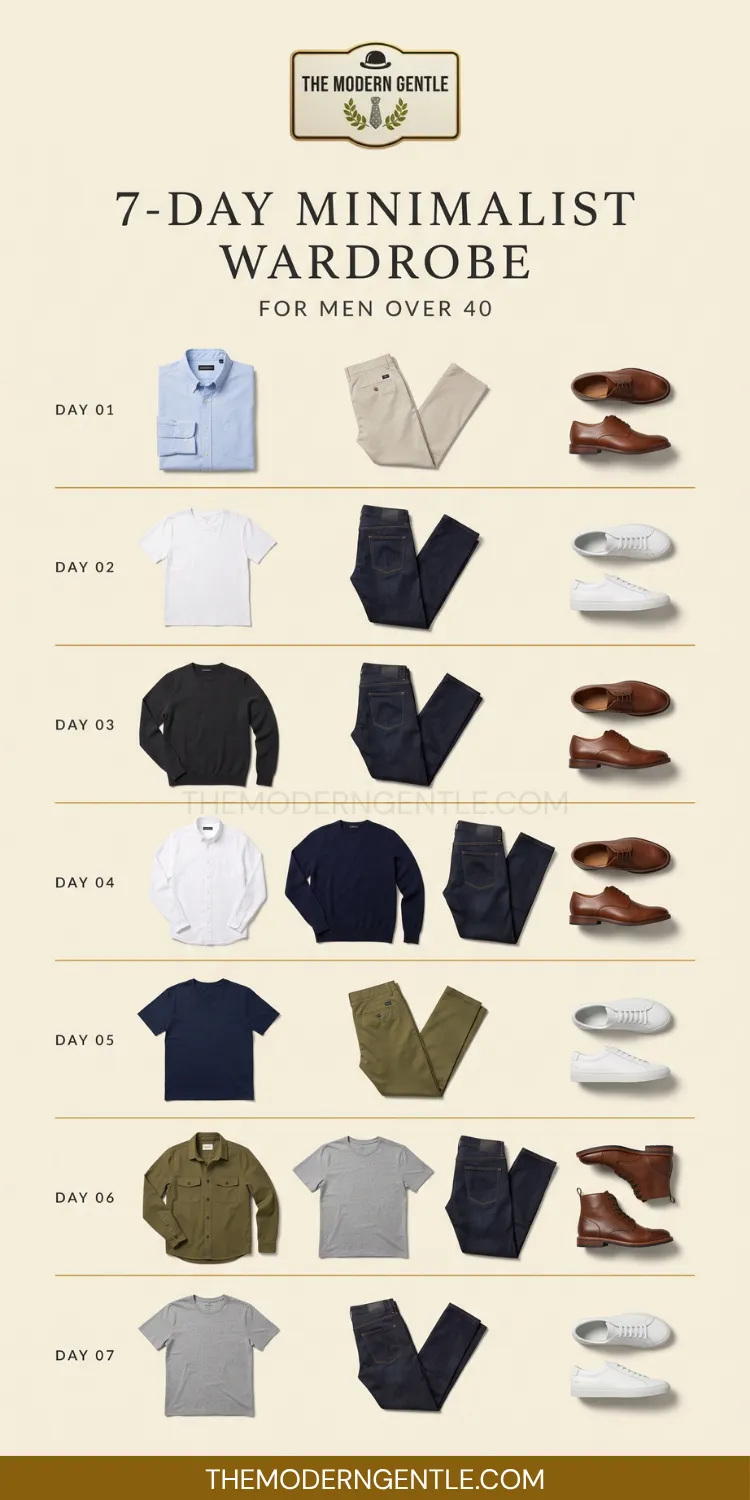
Every look below comes out of this list. Nothing else is required.
That is twelve items and it produces well over thirty workable combinations. Add a brown leather belt that roughly matches your brown shoes and a watch you actually like, and you are done buying for a long while.
Day 1: the office look that does not read as trying

Stone chinos, light blue oxford shirt, brown leather shoes. Sleeves rolled twice to just below the elbow if the room is warm.
This is the outfit where trouser rise earns its keep, and rise is the single most useful thing a man over forty can learn about fit. Rise is the distance from the crotch seam up to the top of the waistband.
A low rise runs somewhere around eight to nine and a half inches and sits on your hip bones. A mid rise, roughly ten to eleven inches, sits at your natural waist, an inch or two below the navel.
Wear a low rise over a fuller midsection and the waistband is forced to sit beneath it. The belt line disappears, your stomach spills over the top, and your legs look shorter because the waistband dropped.
Move to a mid rise and the waistband sits at the narrowest point of your torso instead of the widest. Same body, same weight, and the silhouette reads completely differently.
Do not trust the label
Brands use “mid rise” to mean almost anything. Ignore the word and find the number, which is often buried in the size chart or the product specs. Better still, lay your best-fitting trousers flat and measure from the crotch seam up the fly to the waistband. That figure is your target. Shop by it.
Day 2: jeans and a t-shirt, done properly

Dark indigo jeans, white t-shirt, white leather sneakers.
Nothing simpler exists, which is exactly why the details decide whether it looks deliberate or looks like you gave up.
The variable that matters most is fabric weight, listed as GSM (grams per square metre) on any decent product page.
Under about 150 GSM is lightweight. It drapes nicely in July but it clings, and clinging is the last thing you want over a midsection.
Somewhere between 150 and 180 GSM is the middle ground, and that is where you want to be for most of the year. Above 180 GSM the fabric holds its own shape rather than yours, which is genuinely flattering, though it gets warm.
Weight is not the whole story. A 220 GSM tee made from cheap open-end spun cotton will feel coarse and pill within a month, while a 160 GSM combed ringspun tee will stay soft for years.
If a listing mentions combed or ringspun cotton, that is a better signal than the price.
The hem test
A t-shirt should end somewhere between the top and the middle of your fly. Shorter rides up when you reach. Longer starts to look like sleepwear. This one measurement fixes more casual outfits than any amount of shopping.
Day 3: layering, which is how twelve pieces become thirty outfits

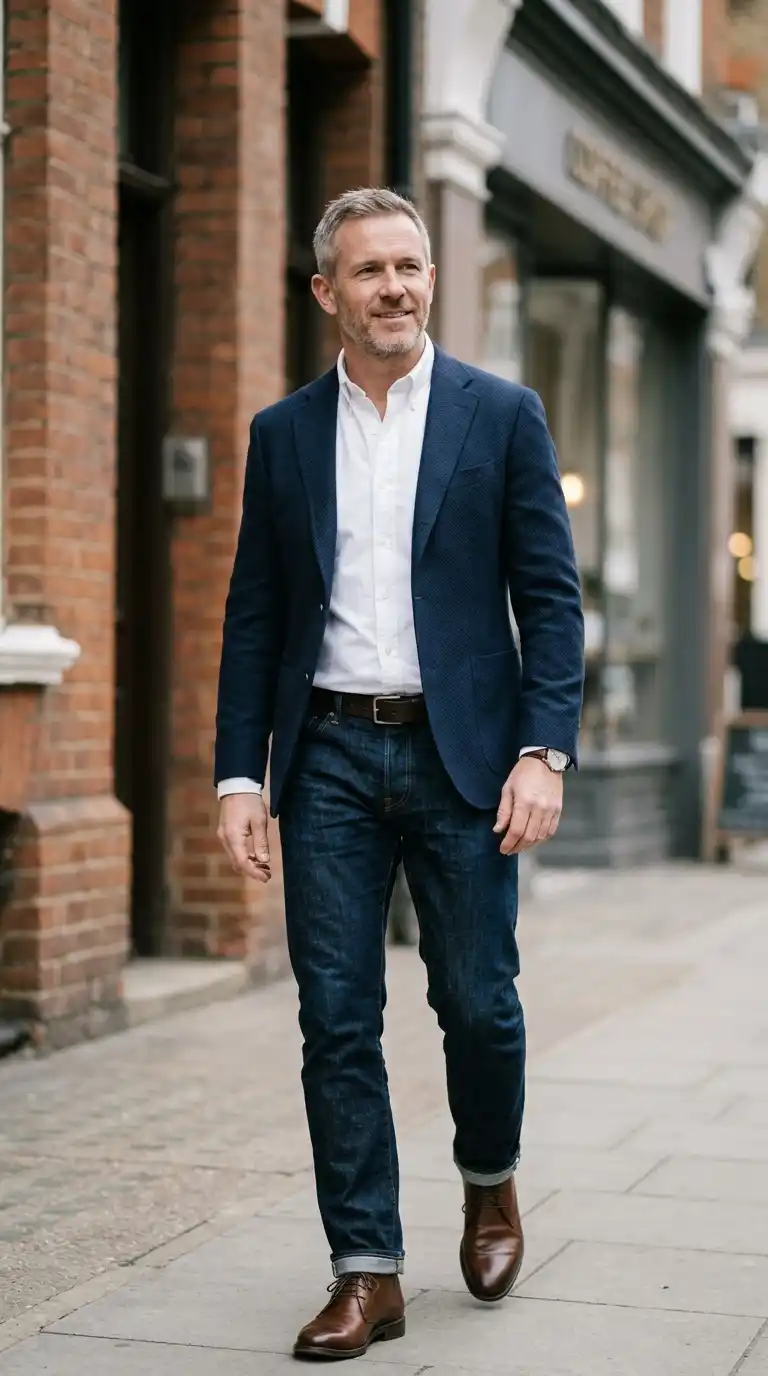
White t-shirt, merino crewneck over the top, dark jeans, brown shoes.
Layering is the mechanism that makes a small wardrobe stop feeling small. Same jeans as yesterday, same shoes as Monday, completely different outfit. Nobody notices repetition when the top half changes.
Two rules keep it from going wrong. First, the layers should get progressively looser as they go outward, so a slim tee under a regular sweater under a slightly roomier jacket.
Reverse that order and you get bunching at the armpit. Second, avoid stacking three items in the same color family, because the eye reads that as one large block and large blocks are not your friend.
Texture does more work than pattern here. Smooth cotton against a ribbed knit against brushed denim gives you visual interest without a single stripe or check.
Day 4: dinner, and why three pairs of shoes is enough

Dark jeans, white oxford shirt, brown leather derbies. Sweater over the shoulders or in the car depending on how you feel about that.
Most men own too many shoes and too few useful ones. Three pairs cover essentially everything a normal life throws at you. White leather sneakers handle daytime and weekends.
Brown leather derbies or loafers handle offices, dinners, and anything with the word “smart” in the invitation. Boots handle weather.
Buy leather over synthetic if the budget stretches, because leather can be resoled and synthetic cannot.
A pair of $180 resolable shoes worn twice a week for six years costs less per wear than three pairs of $70 shoes that get binned when the sole separates. Run that maths once and it changes how you shop.
Rotate or replace
Never wear the same leather shoes two days running. They absorb a surprising amount of moisture over a day and need about twenty four hours to dry out fully. Wearing them wet accelerates the breakdown of the leather and the lining. Alternating two pairs does not double their life, it roughly triples it. Cedar shoe trees help more than polish does.
Day 5: color, and what greying hair changes
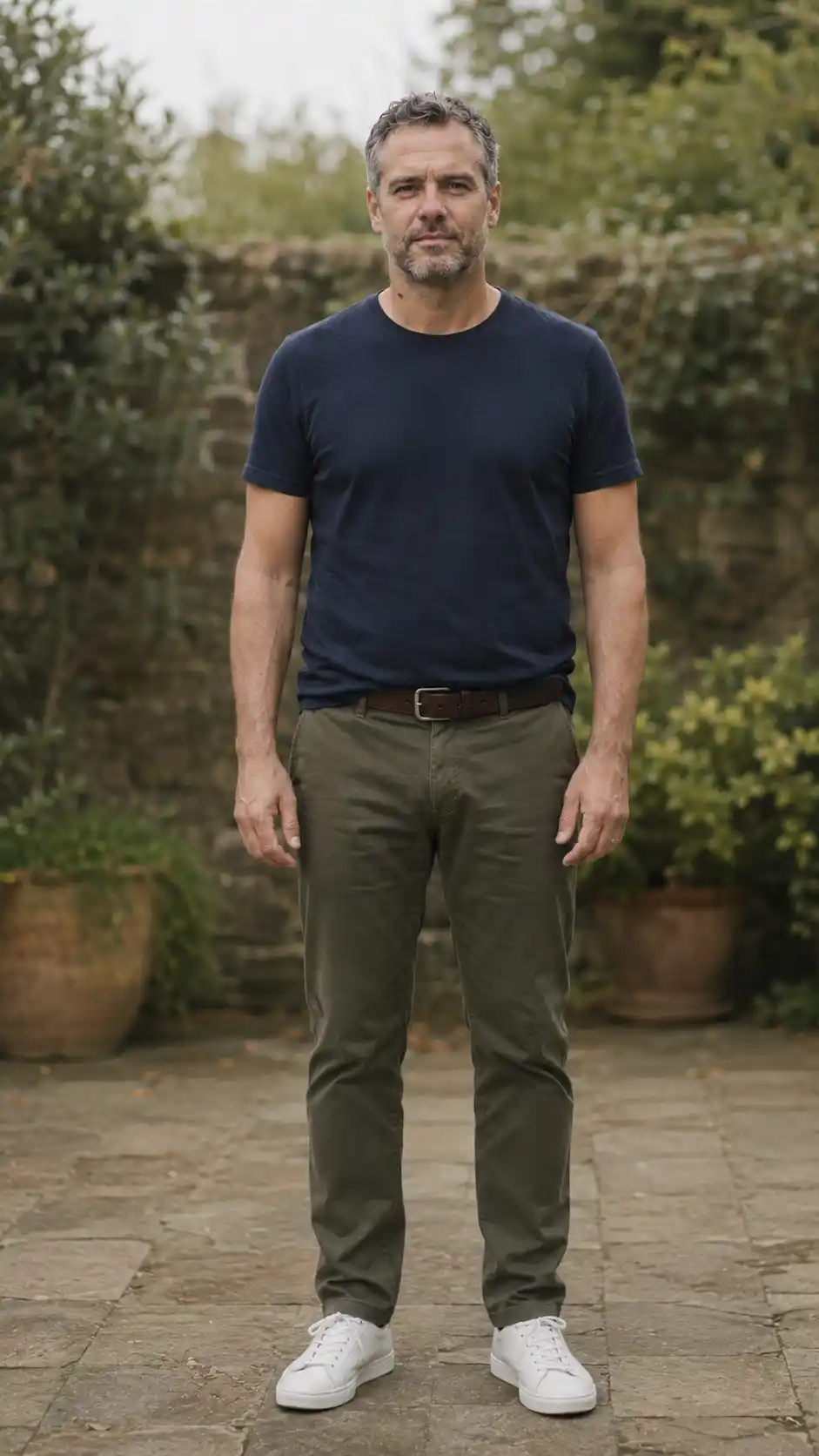
Olive chinos, navy t-shirt, white sneakers.
Here is something that gets overlooked. As hair greys, the contrast between your hair and your skin drops.
Someone who looked sharp in stark black and bright white at thirty often finds the same combination overpowering at fifty, because the outfit now has more contrast than the face does. The clothes end up wearing the man.
This is a styling observation rather than a laboratory finding, so take it as a starting point and check it in a mirror. But it explains why so many men over forty look better in softer, closer-toned combinations: olive with stone, navy with grey, brown with cream.
The colours sit nearer each other on the scale, which keeps the eye moving up toward your face instead of stopping at your chest.
It also means the standard advice to “just wear black” is worse counsel after forty than before it.
Day 6: the weekend outfit that is not sweatpants

Olive overshirt, heather grey t-shirt, dark jeans, boots or sneakers.
The overshirt is the most underrated garment in menswear for our age group. It is cut like a shirt, worn like a light jacket, and it does something specific that matters: an open front creates two vertical lines running down either side of your torso.
Vertical lines draw the eye up and down rather than side to side. That is the whole reason an open cardigan or unbuttoned overshirt is flattering over a fuller middle, and it costs you nothing to use.
Proportion is the thing to watch. Oversized does not read as relaxed after forty, it reads as borrowed. The overshirt should skim your body with enough room for a tee underneath and end at roughly your hip bone.
Day 7: the reset that keeps the system running
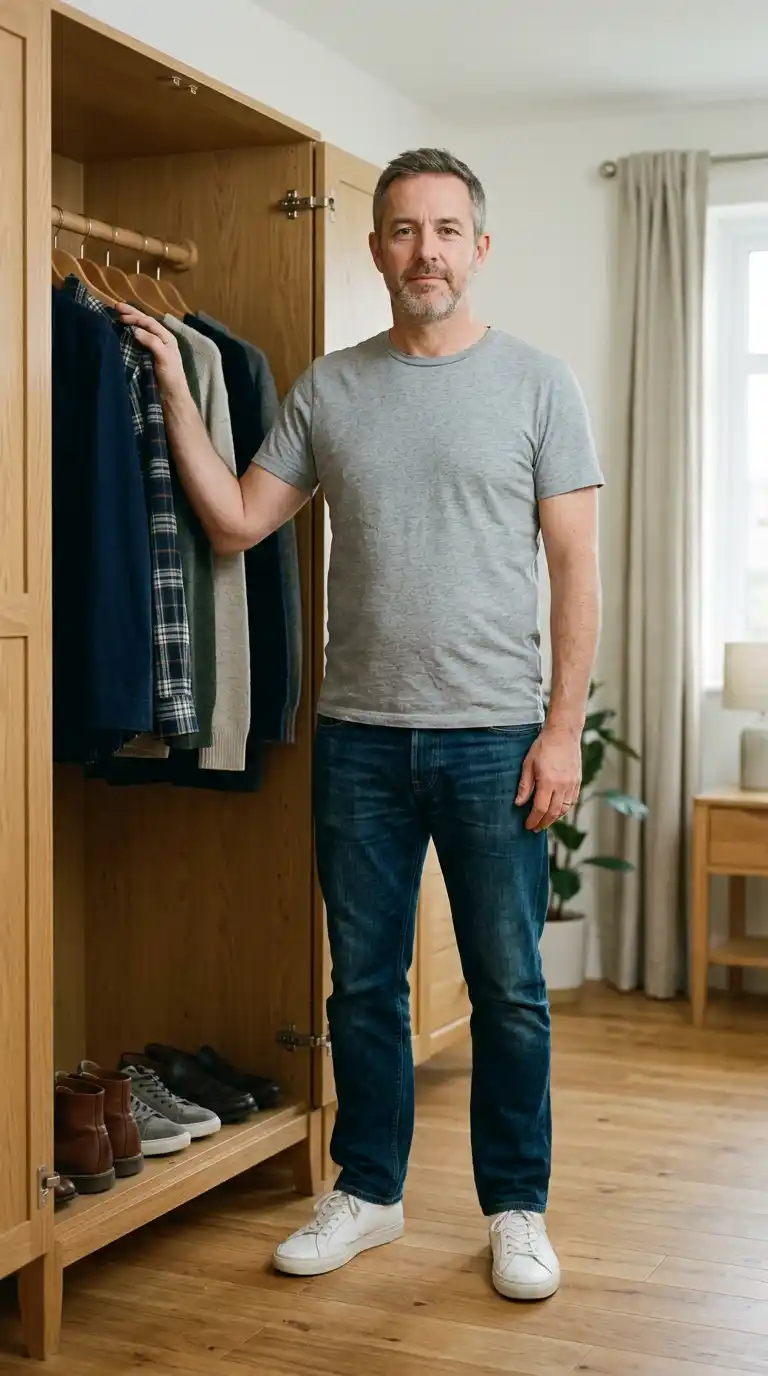
Whatever is comfortable. Sunday is for maintenance, and twenty minutes of it is what keeps the other six days easy.
Pull everything you have not worn in twelve months into a pile. Be honest, because the WRAP figure I mentioned earlier suggests that pile is going to be about a third of your closet.
Sort it into three groups: things that would work if a tailor touched them, things that will never fit again, and things you kept out of habit. Take the first group to a tailor. Donate the rest.
Cheap alterations, large returns
Most men have never had anything altered, which is a shame, because the four most useful jobs are also the cheapest. Shortening shirt sleeves so the cuff sits at your wrist bone. Tapering a shirt body that balloons at the waist. Hemming trousers so there is a single soft break over the shoe. Slimming a trouser leg from the knee down.
Each of these typically runs somewhere in the $15 to $40 range in most US cities. Altering three shirts you already own will do more for how you look than a new shirt costing the same total.
Then wash what needs washing and hang everything by category. Shirts together, trousers together, knitwear folded.
You are not organising for aesthetics, you are organising so that at 7am your eye finds a complete outfit without your brain getting involved.
Four mistakes that undo the whole thing
Sizing up to solve a midsection. Covered above, but it is worth repeating because it is by far the most common. Buy for your shoulders and have the rest taken in.
Buying the piece before the system. If a new item does not pair with at least three things already hanging in your closet, it is not a wardrobe addition, it is a one-outfit purchase pretending otherwise.
Confusing loose with comfortable. Loose clothing hangs from the widest point of your body and drapes outward from there, which makes you look wider than you are.
Clothes that skim, with room to move but no excess fabric, are more comfortable and more flattering at the same time.
Throwing everything out in one weekend. Enthusiasm is not a wardrobe strategy.
You will hit the first cold snap or the first wedding invitation with nothing appropriate, and the panic purchase that follows tends to be expensive and badly judged. Cut in stages over a couple of months.
What this actually costs
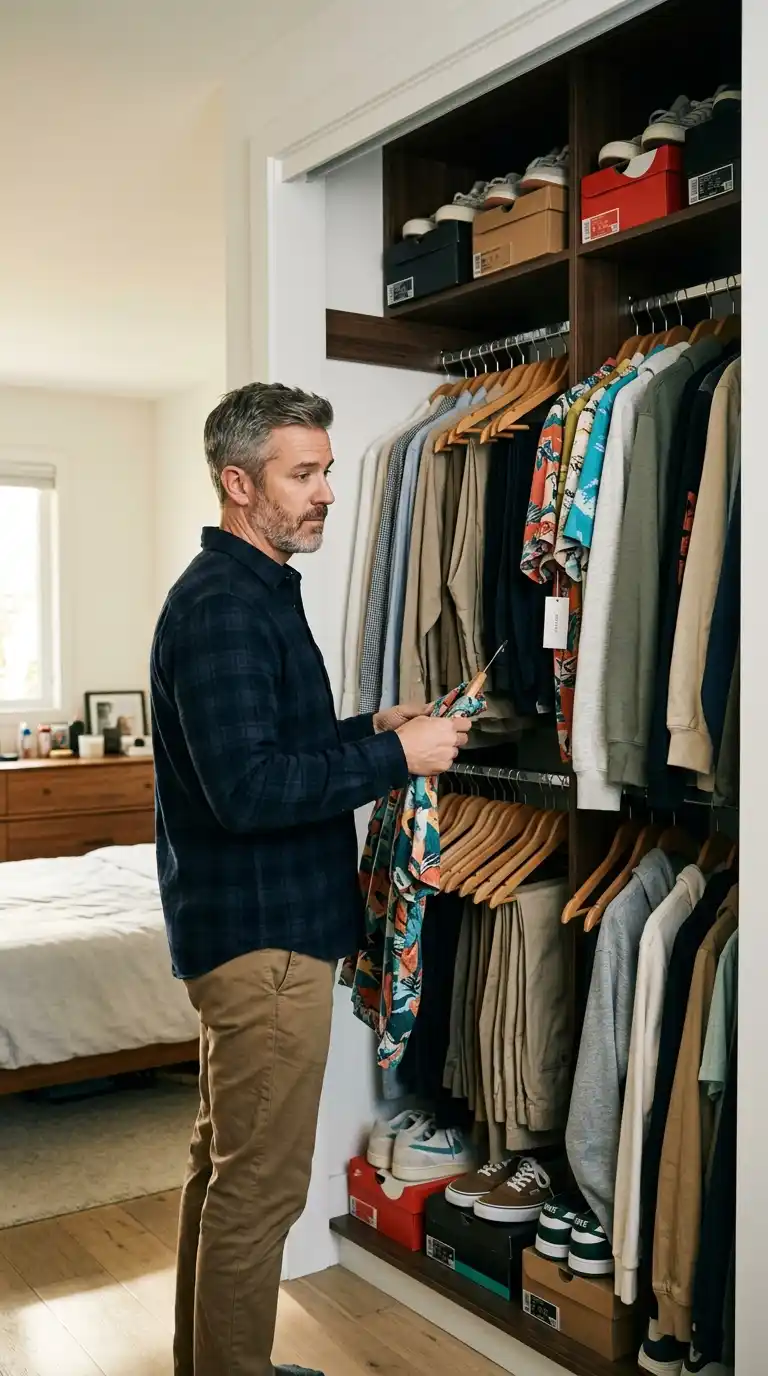
US households spend an average of about $2,001 a year on apparel and services, roughly 2.5% of total spending, according to the Bureau of Labor Statistics Consumer Expenditure Survey for 2024. Around $406 of the 2023 figure went to men’s clothing per household.
Those are not extravagant numbers, which is rather the point. The problem is rarely the total spend. It is that the money gets spread across items that do not combine, so a year of purchases produces a handful of new outfits instead of dozens.
Cost per wear is the metric that fixes this. A $30 shirt worn four times costs $7.50 each time. A $90 shirt worn two hundred times costs 45 cents.
WRAP puts the average garment lifetime at around 2.2 years and found that extending active life by nine months cuts a garment’s environmental footprint by something in the region of 20 to 30%. The same logic works on your bank balance.
Common questions
How many pieces should a minimalist wardrobe actually have?
Twelve core items covers a week comfortably. Most men land somewhere between twenty and thirty once seasonal outerwear and gym clothes are counted. The number matters far less than whether the pieces combine.
Does this work if I work in a suit every day?
The seven outfits above are your evenings and weekends, which is where most men’s wardrobes fall apart anyway. Tailoring runs as a separate system alongside it.
Is minimalist dressing boring?
It can be, if you stop at plain. Texture and fit are what keep a restricted palette interesting, which is why I spend more words on fabric weight and rise than on colour.
What if I lose weight later?
Wait until it stabilises before altering anything, then have your existing clothes taken in. Alterations cost a fraction of replacement, and a tailor can bring most garments in by two sizes without redrafting them.
Where to start
Do not buy anything this week. Pull out your best-fitting shirt and your best-fitting trousers, measure the shoulders, sleeves, and rise, and save those four numbers. Then look at what you already own through that filter.
My guess is that several pieces you had written off are two alterations away from being back in rotation, and a few you wear constantly are the wrong size and always have been.
Style after forty is mostly subtraction. You are not building a new identity, you are removing the pieces that stopped working so the good ones become visible again. That is a much smaller job than it looks like from the doorway of a full closet.

